Freehold, NJ · Garage Door Service
Vista Center's houses date mostly from around 2005, newer than most of the service area, so the doors, springs, and openers that fail here aren't the same as the older stock in town.
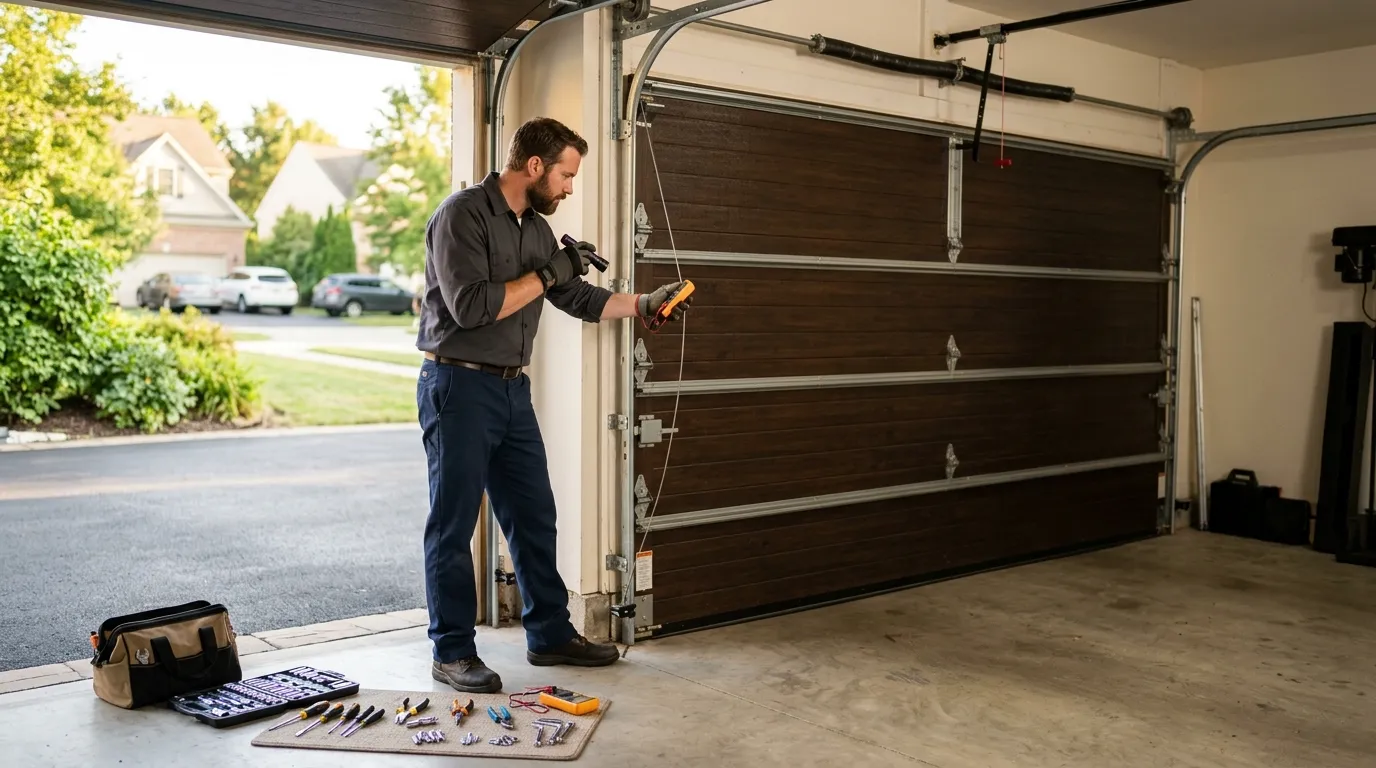
Vista Center's houses are mostly newer builds, median year built around 2005, which means wider two-car openings, factory steel or insulated composite panels, and torsion springs sized for heavier sectional doors than what you'd find on a house from the 1960s. If you're used to older single-torsion setups, don't assume the spring cage on a 2005-era door is the same weight class. A homeowner can safely handle lubrication, tightening loose bolts on the track brackets, and testing the photo-eye sensors for alignment. What you shouldn't touch: the torsion spring itself, or the cable drums under tension. On a wider double door built to current code, the spring is wound tighter and holds more stored energy than the smaller single-door springs common on older stock. That's not a scare tactic, it's just physics that changes with door width.
Because most of Vista Center went up around 2005, the garage door hardware here is largely original to the house and has now put in close to two decades of winters. That's long enough for nylon rollers to crack, for the factory-grade spring coating to fatigue, and for openers from that build era to start failing on logic boards rather than motors. This area sits in the same cold-severe climate band as the rest of the region, so the freeze-thaw cycle on steel tracks and galvanized springs runs the same here as anywhere nearby - the difference is that Vista Center's doors are, on average, younger, so you're more likely dealing with a first-generation failure on original parts than a patched-up door that's been through three prior repairs.
On a 2005-era double door, the first sign is usually the opener struggling on the upstroke - it'll reverse partway, or the wall button will need two or three presses before the door commits to moving. That's a spring losing tension, not a motor problem, even though the motor takes the blame. On single doors from the same build years, you'll hear a metallic pop or see one side of the door hang lower than the other when it's down. Sensor misalignment shows up as a door that reverses the instant it starts closing, which is common once original brackets have loosened over almost twenty years of use. Cracked rollers announce themselves as a grinding rattle on the way up, worse in cold weather when the nylon stiffens.
A spring swap on a double door built to modern width standards takes longer than the same job on an older single door, mostly because the torsion bar and cable drums are larger and need re-tensioning in stages rather than one pull. Opener board replacements on a newer unit are usually faster than diagnosing an old chain-drive motor, since the failure is more likely a single part than a wiring puzzle. We don't carry every logic board for every opener brand on the truck - if your specific model needs a special-order part, that's the one thing that can push a same-day job to a second visit.
Torsion spring replacement on a double door starts with the door secured and the old spring's wind count logged before removal, since a 2005-era door's spring is wound to match its actual panel weight, not a generic size. We replace both springs even if only one has failed, because a mismatched pair on a door this wide throws the balance off within a season. Roller replacement is straightforward on hardware this age - the tracks themselves rarely need swapping, just the rollers and sometimes the bearing brackets. Opener sensor realignment is a five-minute fix once you find the bracket that's shifted; it's usually cosmetic vibration from years of door cycles, not a wiring fault.
We run the 7 miles out from Freehold to Vista Center as a standard service call, not an add-on route, so there's no separate travel charge folded into the estimate. Because the housing here is newer than a lot of what we cover, we bring stock torsion springs sized for wider modern doors on most trucks rather than the older, narrower sizes - it cuts down on the rare case where a part has to be ordered. Book through the coverage page or call in the job description ahead of time so we can confirm we've got the right spring weight loaded before we're on your street.
Yes. Vista Center's housing stock dates mostly to around 2005, newer than much of the surrounding area, so doors tend to be wider, factory-insulated sectional doors on torsion hardware sized for that weight, rather than the older single-torsion setups common on 1960s houses nearby.
About 7 miles. We treat it as a standard service call, not a special trip, so there's no separate travel fee tacked onto the estimate for the drive out.
It's not two years old - most Vista Center houses were built around 2005, so openers original to the house are now pushing two decades old. Logic boards and sensor brackets are the common failure point at that age, more often than the motor itself.
We stock torsion springs sized for modern double-door widths since that's the more common setup in Vista Center. Some opener logic boards are model-specific and occasionally need to be special-ordered, which can push a job to a second visit.
Call now or request a free quote - same-day service on most repairs, upfront written pricing.
