Freehold, NJ · Garage Door Service
Vista Center's homes mostly went up around 2005, decades newer than the rest of the Freehold service area - which changes what breaks first and what the fix costs.
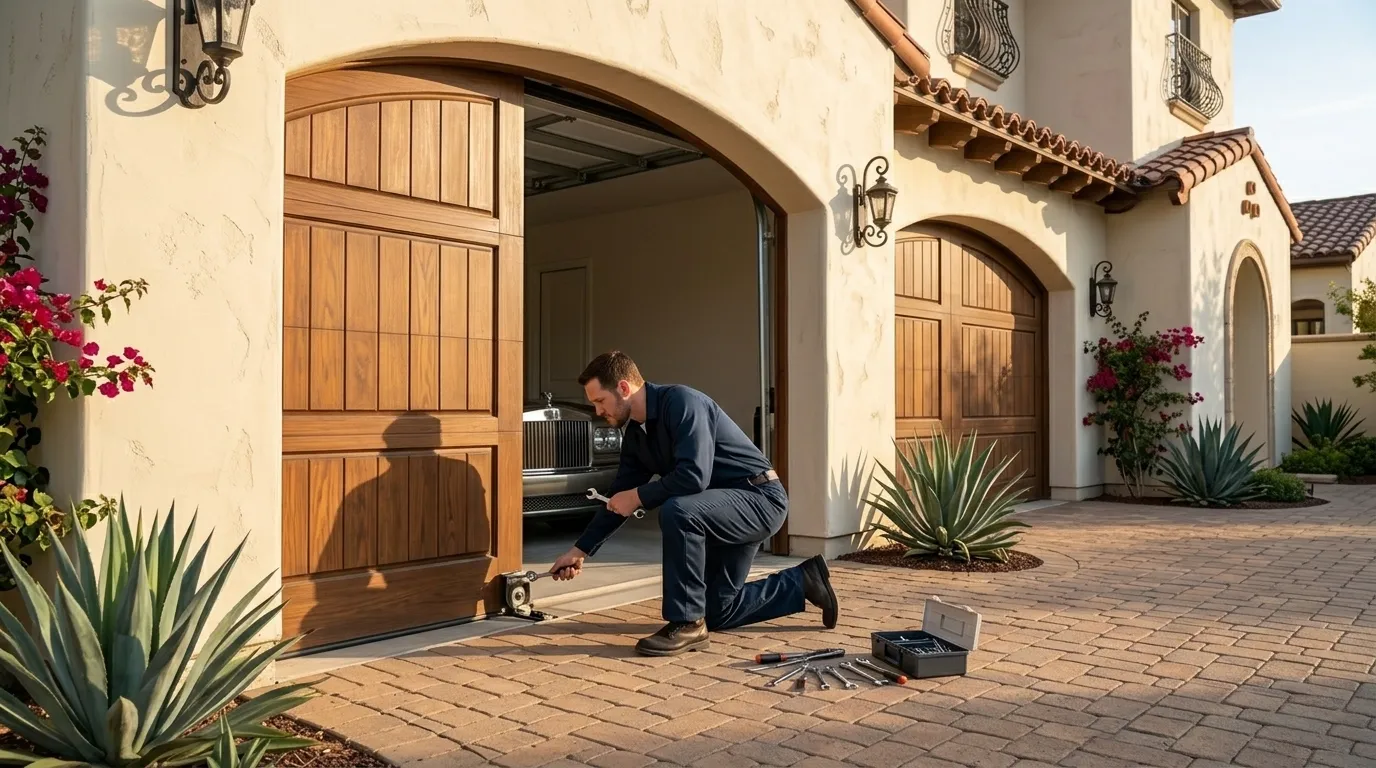
A lot of the small stuff you can handle yourself: swapping a bulb, wiping down the tracks, tightening a loose bracket bolt. Vista Center's homes run newer than most of the area - median build year 2005 - so you're not dealing with the brittle, decades-old hardware that shows up on the 1966-median housing common elsewhere in the service area. That's the good news.
The bad news is that newer doesn't mean simpler. Homes built around 2005 typically carry heavier insulated steel doors on torsion springs sized to match that weight, plus openers wired to photo-eye safety sensors that were already federal standard by then. A torsion spring under that kind of tension can put you in the ER if you try to wind it yourself - we're not going to pretend otherwise. Sensor alignment, weatherstrip swaps, and lubing rollers are reasonable DIY. Spring work, cable work, and anything involving the torsion bar is not, regardless of how new the door looks. If it's under tension, call it in.
Most of the towns we cover - Freehold included - have a housing stock centered on 1966, meaning original one-piece doors, older torsion hardware, and openers that predate today's rolling-code and photo-eye requirements. Vista Center is a different case: a median build year of 2005 means the bulk of these garages were built to a later code cycle, with sectional insulated doors and openers that already had safety reversal sensors built in from day one.
That matters because the failure pattern is different. A 1966-era door fails because the hardware is simply old - springs fatigued from decades of cycles, tracks bent from age. A 2005-era door in Vista Center is more likely to fail because of a part that was cheaper stock even when new: a plastic idler pulley, an opener logic board that wasn't built to last 20+ years, or a photo-eye bracket that's worked itself out of alignment over time. Same symptom - door won't close - different cause, different fix.
On a house from this build era, the door usually still looks fine - the panels aren't dented, the paint isn't chalking - which throws people off. It's not the shell of the door, it's what's behind it.
Common calls we'd expect from a neighborhood like this: the door reverses partway down and won't finish closing, which is almost always a photo-eye that's drifted out of alignment or gotten knocked by a stored bike or ladder. Or the opener runs but the door barely moves, which points to a torsion spring that's lost tension - springs on insulated steel doors from the early 2000s carry more load than the lighter doors common on older homes, so when they go, the opener strains hard trying to lift a door it can no longer counterbalance. We also see circuit boards in openers from this era start failing around now, simply because 15-20 years is close to the end of the road for the electronics, even when the motor itself still runs fine.
We run this from Freehold, about 7 miles out, so there's no separate branch or crew based in Vista Center - every job here is a truck coming from the shop. We're not going to put a number on how fast that truck shows up, because that depends on the day and what's already on the schedule, not on the town.
Once we're on site, how long the actual work takes depends on what's wrong, not on the neighborhood. A photo-eye realignment is a fifteen-minute fix. A torsion spring replacement on a heavier insulated door takes longer than it would on an older, lighter one, because the spring has to be matched to the door's actual weight, not just swapped for whatever's closest. If a part isn't something we carry on the truck - certain opener boards in particular - that's a second visit, not a same-day fix. We'll tell you straight if that's the case instead of promising something we can't deliver.
For a spring job on a house like this, the first step is weighing the door's actual lift requirement, not guessing off the door's age. Insulated steel sectional doors from the early 2000s vary in weight by manufacturer, so the torsion spring gets sized to that specific door, wound to the right number of turns, and tested through a full open-close cycle before we call it done.
For opener issues, we start at the photo-eyes - checking alignment, checking the wiring for corrosion or a loose connector, because that's the most common cause of a door that reverses or won't close on a home this age. If the board itself has failed, that's a straight swap, matched to the opener model already on the wall rather than replacing the whole unit unless the motor's also going. We don't push full opener replacement on a system that's otherwise sound - if the motor's fine and it's just the board, we fix the board.
If your door in Vista Center is doing one of the things above - reversing before it closes, straining against a dead spring, or an opener that just clicks - tell us what you're seeing when you call and we'll get a truck routed out from Freehold. Having the door's age (or at least a guess) and the opener brand on hand speeds up the visit, since it lets us bring the right spring size instead of guessing on site.
You can see what we cover in this part of the county on our coverage page for Vista Center, and if you want the full rundown of everything we handle out of the Freehold shop, that's laid out on our main service page.
Homes here mostly date to around 2005, and the insulated steel doors common on houses from that era are heavier than the older, lighter doors on 1960s housing elsewhere in the area. A heavier door puts more cycles of strain on its torsion spring, so even a door that looks new can be due for a spring swap sooner than you'd expect.
No. We run out of Freehold, about 7 miles away, and send a truck out for every job in Vista Center. There's no separate depot here, so we won't promise a response time tied to a local crew - we're honest about that up front.
Not necessarily. Openers from homes built around 2005 are old enough that circuit boards can start failing, but if the motor and drive are still solid, we replace the board rather than the whole unit. Full replacement only makes sense if the motor itself is going or parts for that board are no longer available.
Call now or request a free quote - same-day service on most repairs, upfront written pricing.
