Freehold, NJ · Garage Door Service
Freehold homes built between 1938 and 2005 carry original torsion hardware that cold winters push past its limit. We fix springs, cables, and openers on the original gear.
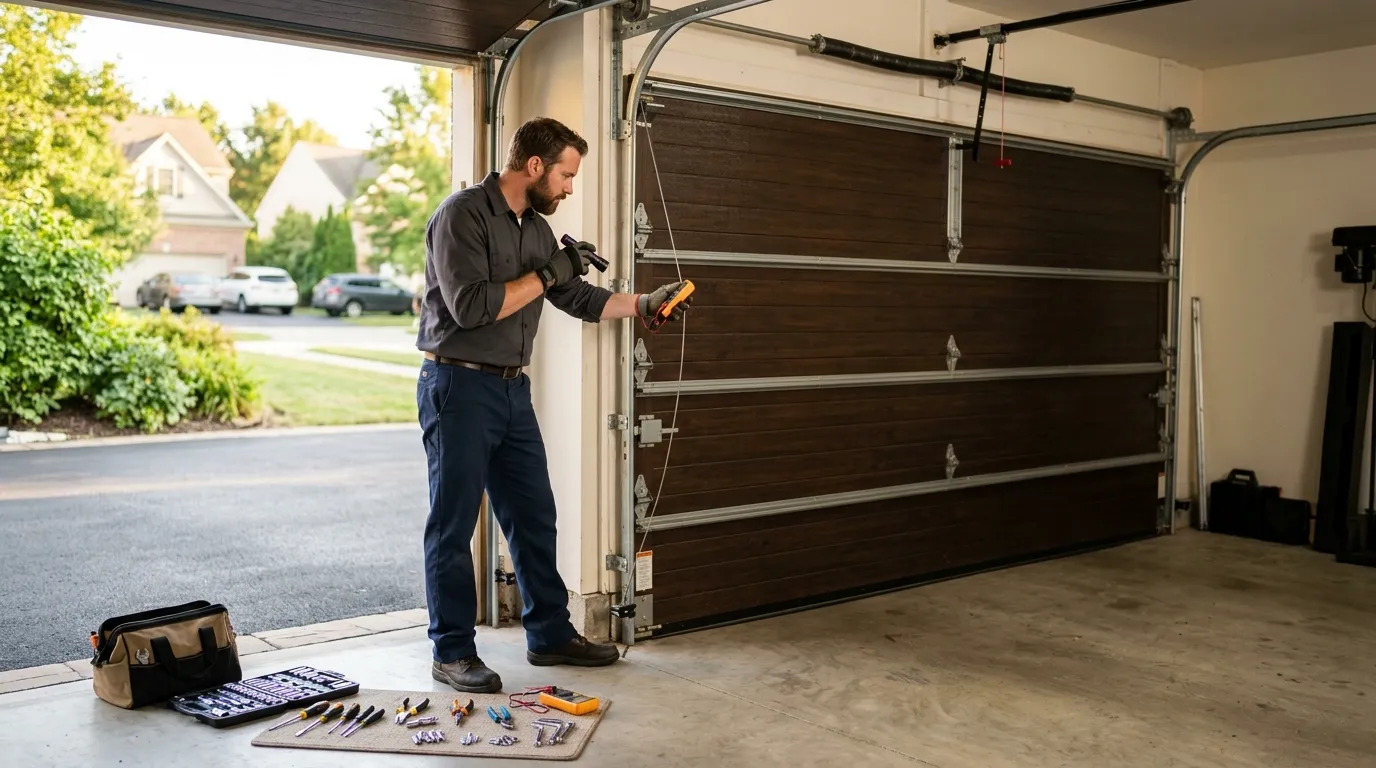
Most calls we take in Freehold come down to one of three things: a broken torsion spring, a snapped or frayed lift cable, or an opener that's grinding through its last few cycles. We start by pulling the door manually to see where the resistance or slack actually is, because a door that won't open can be a $200 spring job or a $600 opener job, and guessing wrong wastes your afternoon. On a house built in the median year around here, 1966, the torsion hardware is often the original side-mounted setup - not the center-mounted torsion tube you see in newer construction. That changes which parts we carry on the truck and how the job gets billed. We replace springs in matched pairs even if only one broke, because the other one is the same age and close behind it. Cables get swapped at the same time if they're original, since pulling the drum apart twice costs you a second call. One limitation worth saying plainly: if the door itself is warped or the track is bent from years of a spring dragging on it unevenly, spring replacement alone won't fix the symptom - at that point we tell you honestly when it's a track or panel job instead.
The door won't budge, or it moves a few inches and stops. Sometimes it's a loud bang from the garage before anything else happens - that's the spring letting go, usually overnight when the temperature drops fast. Other times the opener runs but the door doesn't move, which points at a cable off the drum rather than the spring itself. On the older side-mount torsion setups common in houses from the 1950s through 1970s here, the failure point is usually the spring itself, since the hardware wasn't built for the cycle counts a garage door racks up over 50-plus years. On newer builds - closer to the 2005 end of the range - it's more often the opener's circuit board or a sensor that's drifted out of alignment, since those doors were built with torsion tubes rated for longer service life. Either way, if the door drops fast when you pull the release cord, don't force it back down by hand. That's a loaded spring problem, not an opener problem.
A straight spring swap on a single door is usually a same-visit repair - we bring standard spring sizes because the local housing stock is consistent enough that we know what to expect before we get there. Cable replacement adds a bit of time since we're unwinding the drum under tension either way. Opener repairs vary more: if it's a sensor or a logic board issue, that's often resolved on site, but if a specific opener model needs a part we don't stock on the truck, that becomes a return visit. We don't pad the estimate to cover a part we're guessing about - we tell you what we see and what we don't.
Freehold sits in a severe cold climate band, and steel torsion springs lose a measurable amount of tensile strength as they cycle through repeated freeze-thaw swings each winter. A spring rated for 10,000 cycles doesn't care what season it is, but cold steel is more brittle steel, and January mornings are when we get the most break calls. Combine that with a housing stock built mostly in the 1960s and 70s across the area - homes never designed with today's insulated, heavier doors in mind - and you get original hardware straining under loads it wasn't sized for once an owner upgrades to a heavier insulated door. This isn't a problem tied to any one street; it's a function of when the neighborhood went up and what the winters do to steel every year since. Houses closer to East Freehold and Stonehurst East and West, some of the older sections near town, tend to still have their original springs simply because nobody's replaced them yet - which means they're overdue, not exempt.
Cold makes steel more brittle, and Freehold sits in a climate zone with real winter swings. A spring already worn down by years of cycling is more likely to snap on a cold morning than a mild one. It's not bad luck tied to one day - it's the cumulative wear finally giving out when the metal is least flexible.
We replace both springs in a pair even if only one failed. They're installed at the same time originally, so if one has worn out from cycling, the other is close behind it. Replacing one and leaving a decades-old spring next to it just means a second service call in a few months.
Often, yes. Homes in this area built through the 1960s and 70s frequently have side-mounted torsion hardware rather than the center-mounted torsion tube you'd find in a house built closer to 2005. We check which setup you have before quoting, since the parts and labor aren't identical.
Call now or request a free quote - same-day service on most repairs, upfront written pricing.
